
Skip to content

Campaign

Digital inclusion campaign for people with autism in Germany

This campaign aims to promote the digital inclusion of people with autism in Germany by raising awareness and promoting digital accessibility. Through engagement on social media, personal testimonials, and expert discussions, the initiative highlights the importance of digital tools for the advancement of autistic people.

I want to help

Aim of the project

  • Raise awareness of the challenges and opportunities of digital integration for people with autism.
  • Promote accessible digital tools that improve learning, communication, and independence.
  • Foster social dialogue through personal stories, expert knowledge, and online discussions.
  • Encourage stakeholder collaboration, including non-governmental organisations, technology companies, educators, and policymakers.

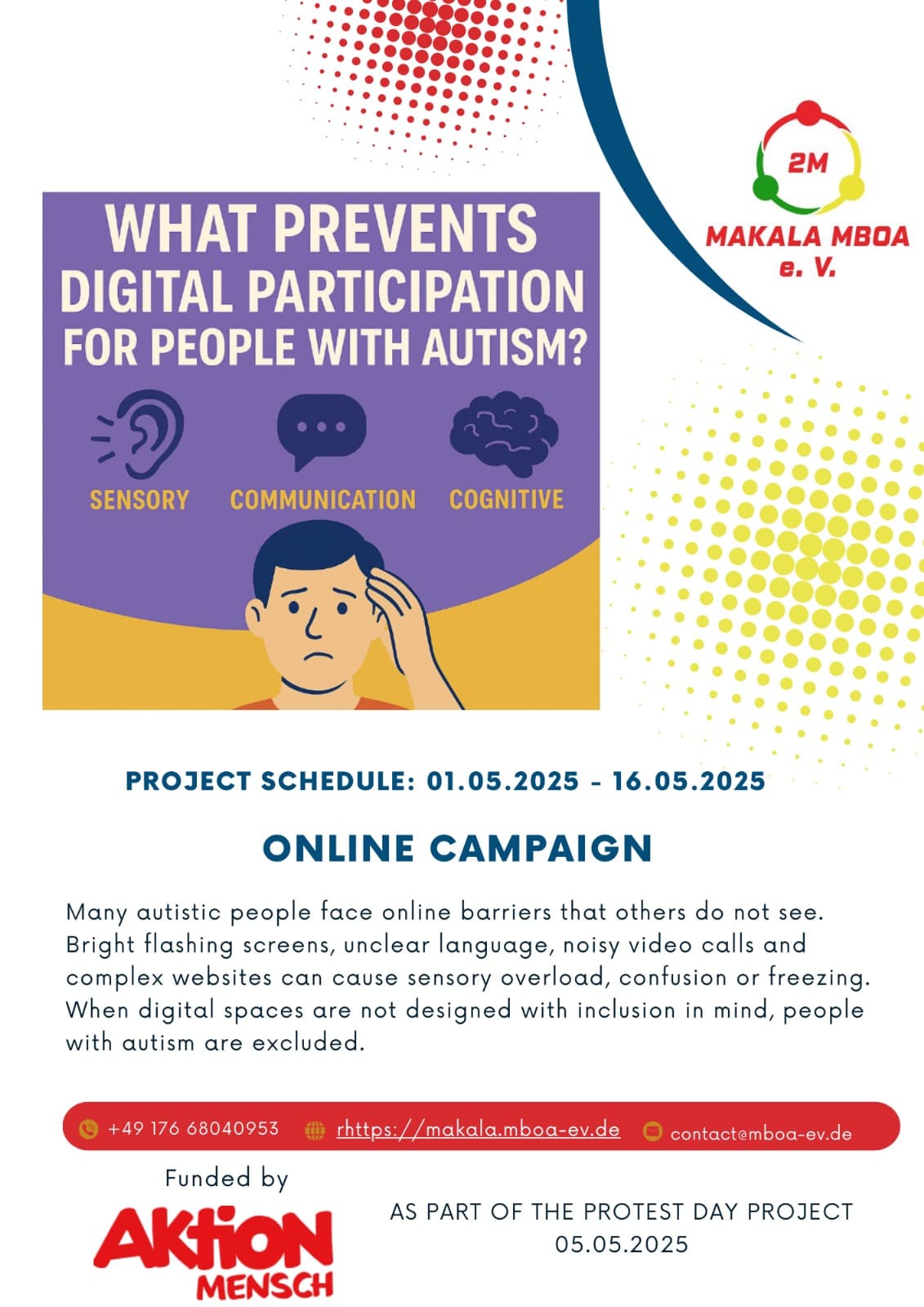
What prevents digital participation for people with autism?

Many autistic people face online barriers that others do not see. Bright flashing screens, unclear language, noisy video calls and complex websites can cause sensory overload, confusion or freezing.

  • Paul (24)Berlin

    Every time I log in, I feel like my brain is under attack. The colours change suddenly, things move around. I lose my concentration within seconds.
    Barrier
    Sensory overload caused by poor digital design — visual clutter, animations, sounds.
    Impact
    Avoidance of essential digital platforms, leading to a disadvantage at university.
  • Marah (31)Hamburg

    When the system assumes that I can speak or hear, I am automatically excluded. If there is no chat or written option, I cannot participate in the conversation.
    Barrier
    Lack of communication alternatives and rigidity of platforms.
    Impact
    Reduced access to employment and essential services.
  • Samuel (19)Cologne

    It took me several days to fill out the disability assistance application form. I couldn't even find the button to start the form.
    Barrier
    Cognitive overload, inaccessible language and poor user experience design.
    Impact
    Inability to independently access essential public services.

Making the web autism-friendly

Many websites are overwhelming or confusing for autistic users. Here is how to make yours more accessible:

  • Use clear, consistent navigation.
  • Avoid autoplaying videos and distracting animations.
  • Offer text alternatives — chat, transcripts, image descriptions.
  • Use plain language, or an easy-read version.
  • Let users adjust the display — font size, contrast and more.

Small changes, big impact. Design with everyone in mind.

I want to help